
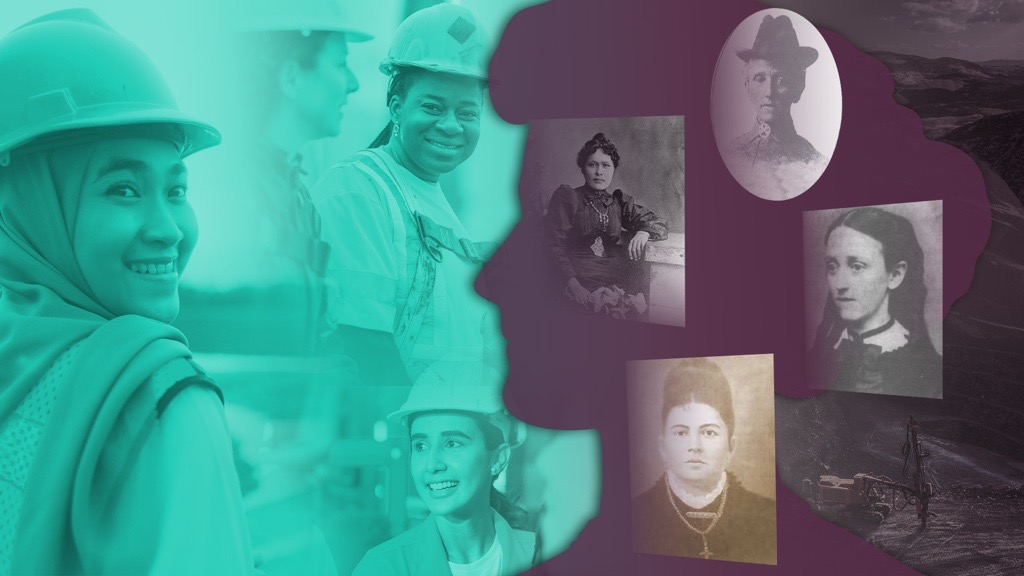
Published in recognition of International Day of Women in Mining (IDWIM) by Dr. Marvin Thompson
On August 17, 1896, beside a creek in what is now Yukon Territory, Canada, a Tagish First Nation woman named Shaaw Tláa, saw something that the world would spend more than a century trying to explain without fully centering her in that history.
Indigenous oral histories say Shaaw Tláa, also known as Kate Carmack, noticed the gold while fetching water for tea. Other accounts credit her brother Keish, also known as Skookum Jim, as the “discoverer.” Together with Ḵáa Goox̱, also known as Dawson Charlie, and George Carmack, a non-Indigenous prospector and husband of Shaaw Tláa, their discovery helped trigger the Klondike Gold Rush and remains inseparable from the Indigenous knowledge, relationships with the land, and contributions that made it possible.
The popular story, however, would largely center George Carmack, who was historically credited with registering the Discovery Claim associated with the gold discovery that set off the Klondike Gold Rush. Tens of thousands of people would eventually pour into the Klondike, making and losing fortunes, while Shaaw Tláa’s role in the discovery would take 123 years to be formally recognized within that history.
That is where the history of women in mining becomes more interesting than a simple tale of “firsts”.
The question is not whether women were there. The more important question is how an industry could be built with women inside the work, around the work, and often ahead of the work, while later telling its own story as though women had only recently arrived.
As I began researching for this article, the patterns began to appear everywhere. Women appeared in patents, claim records, geological surveys, family mining economies, oral histories, and across nearly every segment of mining. Another pattern that was quickly noted was that women were not always named in the way men were named. They weren’t placed in the foreground of the accounts researched, even when they were the catalyst for discovery or innovation. Some of their contributions were treated as assistance, curiosity, or even as a threat.
Nearly three centuries before Shaaw Tláa was inducted into the Canadian Mining Hall of Fame. A French noblewoman named Martine de Bertereau was testing the boundaries of what was “permitted” to know about the earth. Bertereau, born around 1590, conducted systematic mining survey across France and the Low Countries with her husband. She was knowledgeable about mineral deposits, was an advisor on mines and produced written work that belonged in European mining technical history. However, her knowledge and expertise were ahead of a world that had little room for a woman who could read the ground with accuracy, technical capability, and authority.
As a result of “challenging” the status quo, Bertereau and her husband were eventually imprisoned, being accused of sorcery. The accusation reveals more about the social conditions and anxieties of the time than it does about the couple themselves.
Her story has often been presented as a strange or odd episode from an older time, but it also exposes an enduring habit in mining history: when women’s expertise could not be easily dismissed, it could be made to appear “suspicious”.
By the 19th century, this “suspicion” had been hardened and codified into law. In Britain, the Mines and Collieries Act of 1842 prohibited women and girls from working underground. The Act was framed in the language of “protection”. This wasn’t a meaningless consideration given the brutality of mining work at the time. However, this Act formalized a narrowing of “who” could be recognized as a mining worker. It provided a legal framework that reinforced the cultural belief that underground mining belonged to men. It shaped who was remembered, who appeared in statistics, and whose contributions were documented.
When people say mining has always been men’s work, they are often describing a history shaped by law, culture, moral anxiety, and recordkeeping, not a natural state of affairs. In 1842, Britain made one of those decisions explicit by prohibiting women and girls from working underground. Over time, the consequences of that decision came to look less like policy and more like tradition.
This is how tradition often works. A decision is made at a particular moment, usually under particular social pressures, and later generations mistake the result for the natural order of things. I tend to refer to them as “codified agreements”, but not everyone knows the code.
Ferminia Sarras entered the Nevada mining record in the 1880’s like a figure from a movie no one had yet learned how to make. Of Nicaraguan heritage, Ferminia was often misidentified in the racial language of the period as “Mexican” or “Indian”. Almost like a scene from a movie, she prospected alone, wearing pants and carrying a six-shooter when the situation required it. Given the mining culture of the period, organized around male credibility, she approached her world as if the desert would judge her more fairly than people would. In many instances, she was right.
Her first major sale came in June 1902, when investors bonded 25 of her copper claims at $8,000 each. A month later, newspapers announced the sale of the famous Sarras Group of 40 claims for $90,000, a fortune at the time. In 1907, she sold another group of claims for $65,000, further expanding fortunes for herself and others. At current metal prices, production of that scale represents extraordinary modern value even without direct historical comparison.
Carrie Everson’s contribution came from a different part of mining, not from a desert claim but from the science of separating value from waste. Everson was an American school teacher and inventor who, in 1886, patented a process for concentrating minerals from ore using oil, chemistry and agitation. Her work was in advance of later techniques that became central to flotation, one of the most important developments in modern mineral processing.
Once again, the familiar pattern returned. After receiving poor legal advice, she lost the benefit of her patents and watched related processes later advanced and commercialized by others. Two years after her death, The Mining Journal wrote, that as a metallurgist, she had been a quarter century in advance of her profession. Her profession eventually recognized her ideas and inventions; recognition simply did not find its way back to her in real time.
These stories are not identical, which is why that matters when put together. Bertereau’s knowledge was made dangerous. Shaaw Tláa’s role was pushed to the side by a public story that preferred a different center. Sarras was treated as an exception before the value of her claims made doubt look foolish. Everson contributed to the future of mineral processing before the system of recognition could hold her contribution properly. This pattern is not evidence of absence. It is evidence filtered through institutions that often failed to document, credit, protect, or retain women’s contributions.
For years, the case for women in mining was often spoken in the language of fairness, equity, and inclusion. There is something necessary in those arguments, but mining is also an industry that listens closely when the language turns to risk, productivity, governance, capital discipline and sustainable value. Within those dimensions of mining, the evidence has become increasingly difficult to ignore.
A 2025 systematic review of 79 peer reviewed studies found a consistent positive relationship between female leadership and stronger ESG reporting, particularly when women hold meaningful decision-making authority. Using data from 2,646 public companies across Europe, the Americas, and Asia, another 2025 study found a significant positive relationship between gender-diverse leadership and corporate sustainability performance. These studies are not ‘mining only’ studies, but that does not weaken their relevance to mining. Mining is among the industries most exposed to environmental scrutiny, community trust, safety risk, permitting pressure, and long investment horizons. If gender-diverse leadership strengthens governance and sustainability performance across complex companies, mining has every reason to pay attention.
This is not to say that women improve an industry simply by being counted and present. This is only the beginning, as the stronger finding is that organizations benefit when women have influence, authority, and access to the decisions that shape work. In other words, the impact doesn’t come from presence alone, but from participation with authority.
In mining that distinction is critical, because the industry’s future will be decided not only by what it extracts, but by how it manages risk, earns trust, develops talent and defines safety.
Australia offers one of the clearest examples of that last point. Professor Sharon Parker and colleagues brought mining safety into a broader frame. Her research examined the lived experiences of thousands of mining workers and placed mental health, well-being, sexual harassment, respectful culture, emerging mine safety issues, and the future of work inside the same conversation. This matters because the mine of the future will not be judged only by whether workers leave without physical injury. As workforce demographics change, expectations are also changing. Mines will increasingly be judged by whether systems of work, leadership behaviours, camp environments, workplace cultures, and psychological safety, create conditions of respect that enable people to do their best work.
In a sense, women are not merely entering mining’s existing safety culture; they are helping expand the industry’s understanding of what safety must mean for the future.
The same shift can be seen in leadership succession. In 2024, Kathleen Quirk became CEO of Freeport-McMoRan after more than three decades with the company. Her appointment came at a moment when copper had become central to the industrial future now being built around the world. This is a succession story, the result of a company retaining and recognizing executive capability long enough for that capability to be available when the stakes were high.
Natascha Viljoen joined the ranks of mining CEOs on January 1, 2026, making her the incoming leader of the world’s largest gold mining company by production. Mining has spent years speaking to the need for talent, technical excellence, operational discipline and leadership capable of managing these complexities in a complex environment. Women have been building those capabilities throughout the industry. The question is whether companies are willing to keep women long enough through recognition and development early, and for those at the top of the organization to reflect on the depth of the talent pool below it.
Today, women account for about one-third of the global artisanal and small-scale mining workforce. This is a sector of mining that supplies minerals that are essential to modern technology and energy transition taking place all over the world. In many of these instances, these women work under legal and social conditions that restrict their access to claims, finance, safety protections, and economic opportunity, let alone equitable access to development opportunities. The energy transition is not simply a story about critical minerals, but also about whether the world will rely on women’s innovation and labour, at the cost of women’s rights, safety, and recognition behind.
Annually, on the 15th of June, the global mining industry is invited to commemorate the International Day of Women in Mining (IDWIM). This day is more than a celebratory date on the industry calendar. It is a correction to the industry’s memory, and a reminder that many contributions were not absent; they were simply not always recognized in the stories that were recorded. This day is a reminder of the aspirations and capabilities of women whose contributions have been visible to those who work beside them.
Celebration, when in the right context, is not sentimentality, it is about intentionality. It says that Shaaw Tláa belongs in the story of the Klondike. It says that Martine de Bertereau belongs in the technical history of mining exploration. It says that Ferminia Sarras belongs in the history of Nevada prospecting, not as a pants wearing, gun carrying curiosity, but as a serious prospector whose claims carried lasting value.
It says that Carrie Everson belongs in the history of mineral processing. It says that women shaping psychosocial safety, ESG governance, executive succession, artisanal mining, operations geology, metallurgy, engineering, community relations, and digital transformation, are not asked to be added to mining from the outside. They Were Already Building It.
Like most work environments, the mine of the next 20 years will not look like the mine of previous 20 years. It will become more automated, data-driven, scrutinized, dependent on community trust, and more exposed to the pressures of the energy transition. It will require people who can manage physical and psychosocial hazards, technical systems, human capability, and capital discipline. The old story that mining is “naturally” men’s work in not only historically incomplete, but it’s also strategically obsolete.
Four centuries of evidence point to a different conclusion: Women were not waiting for mining to become ready for them. Women were surveying deposits, staking claims, inventing processes, sustaining supply chains, leading companies, reshaping safety, and holding communities together while the official record took its time catch up.
The women in this article were not waiting to be celebrated; they were building something. The history has never only been about inclusion; it has also been about impact.
About the Author
Dr. Marvin Thompson, Ed.D. is President of TeamsynerG Global Consulting. His work focuses on psychosocial hazard prevention, leadership execution, and policy-aligned operating systems in complex, people-intensive environments including mining, construction, healthcare, and education. He is the co-developer of the Whole Person Safety® framework and co-author of SAFE UNTIL IT ISN’T.
Selected References
Shaaw Tláa, Kate Carmack, WIM Canada (Women In Mining Canada)
Ferminia Sarras, Nevada Women’s History Project(nevadawomen.org)
UK Parliament, Coal mines and the 1842 Act (Parliament News)
Legislation.gov.uk, Act text (Legislation.gov.uk)
ANU Research Portal, Lahiri-Dutt article record (The Australian National University)
National Mining Hall of Fame and Museum(mininghalloffame.org)
Dawn Bunyak, The Inventor, the Patent, & Carrie Everson: Defining Success (mininghistoryassociation.org)
Mining History Association, Winter 2008 Newsletter(mininghistoryassociation.org)
WA Government, MARS Preliminary Report 2B (Western Australian Government)
Future of Work Institute, MARS Landmark Study event page(Future of Work Institute)
World Bank, Gender Equality in ASM press release (World Bank)
EGPS / World Bank blog, women in ASM(egps.worldbank.org)
The Accounting Journal of Binaniaga, article page(tajb.unbin.ac.id)
The Accounting Journal of Binaniaga, PDF (tajb.unbin.ac.id)
Wiley, Business Strategy and the Environment (Wiley Online Library)
Freeport-McMoRan leadership transition announcement(investors.fcx.com)
Kathleen L. Quirk profile, Freeport-McMoRan (fcx.com)
Newmont CEO succession announcement (newmont.com)