






Mental Health Awareness Month
Psychological Harm Prevention in the Workplace: Protecting Mental Health with System-Level Responsibility
Date: May 27th, 2026
WEBINAR TIME
| 90 minutes (including Q&A)
limited spaces available
Facilitated by: Audrey Hlembizky, Val Vanderwyk and Mike Parent
Presented by: TeamsynerG Global Consulting
Preventing Psychological Harm in the Workplace
![Two professionals discuss workplace psychosocial hazards, with a large puzzle-piece brain graphic in the background.”],](https://teamsynerg.com/wp-content/uploads/2026/04/Psychological-harm-prevention-and-optimizing-mental-heath-at-workWebinar.jpg "Psychological harm prevention and optimizing mental heath at workWebinar | TeamsynerG Global Consulting | TeamsynerG Global Consulting")
Organizations are investing more than ever in mental health. At the same time, many continue to experience persistent challenges related to burnout, fatigue, disengagement, and reduced capacity across their workforce.
This raises an important question. Are current approaches addressing the root causes of harm, or primarily responding to its effects?
Mental health is an outcome influenced by multiple factors. One of the most significant is the work environment itself. Psychological harm can arise from conditions such as excessive or conflicting demands, unclear roles, limited decision authority, inadequate support, and inconsistent leadership practices. When these conditions are not identified and managed, they contribute directly to negative mental health outcomes.
This session will examine:
✓ How current ways of working are creating conditions that increase exposure to psychological hazards, often without being recognized as risk
✓ Where organizations are over-relying on support mechanisms and awareness initiatives, while underlying causes remain unaddressed
✓ What is required in practice to redesign work, including workload, role clarity, and decision authority, to reduce exposure to harm at its source
✓ The role of leadership, decision-making, and accountability in preventing psychological harm, beyond stated values and intentions
✓ Emerging risks as work continues to evolve, including the impact of technology on human capacity, identity, and perceived value within the workplace
About Audrey Hlembizky
Audrey is a global leader in culture engineering, leadership development and innovative human workplace design. She is the CEO and Founder of TeamsynerG Global Consulting and has more than 35 years of experience transforming how organizations and leaders think, lead, and perform. Audrey’s work sits at the intersection of safety, human behaviour, and systems, and it comes from years of listening to people who carry responsibility, risk, and consequences every day.
Audrey, alongside Dr. Marvin Thompson is the co-creator of the Whole-Person Safety System and co-author of their upcoming book SAFE UNTIL IT ISN’T.
Human safety is the driver behind several of their proprietary methodologies including BIOPTRICS™, the first human-centered digital system that integrates behavioural learning, culture-health diagnostics, and workforce-development optimization into one unified platform. Recently they have also received global certification from the World Certification Institute a global authority in occupational certification for their Psychosocial Hazard Prevention Management Program.
About Val Vanderwyk
Valerie is a proud Mi’kmaq woman whose family originated from Nova Scotia and New Brunswick.
In 2014, Valerie was nominated for a Woman of Distinction Award with the YWCA in Hamilton, ON for her work creating Ontario’s first pre-apprenticeship training program in Welding and Plumbing for Women.
Working with the Aboriginal Apprenticeship Board, Valerie was brought on to the team in 2019 as a Community Engagement Coordinator to assist with the organization’s national expansion into the provinces of British Columbia, Alberta, Saskatchewan, and New Brunswick. Engaged in ensuring that Indigenous youth and their communities received equitable consideration for education and employment opportunities in apprenticeship, Valerie coordinates with stakeholders for the inclusion of Indigenous people with partners and was recently appointed as Executive Director. Valerie is leading the transition of the Aboriginal Apprenticeship Board of Ontario to the Indigenous Skills, Employment, Apprenticeship and Development as a federally registered national not-for-profit, expanding the organization’s reach and presence.
With a deep passion for Occupational Health and Safety, Valerie partners with the province of Ontario’s designated training centre – Workers Health and Safety Centre. Making occupational health and safety a primary focus of their work at ISEAD, their efforts are fundamental to ensuring the safety of Indigenous workers through meaningful training and compliance with legislation and regulations across all sectors. Valerie has been a certified occupational health and safety instructor across all sectors since 2014.
Valerie is on the Board of Directors with the Aboriginal Skilled Workers Association (ASWA), the Canadian Apprenticeship Forum – equity seat, Roots to Roofs, the Treasurer of the Grand Valley
Education Society (GVES), and the President of the Anangokaa Stardust Festival, encouraging Indigenous youth to consider opportunities in the aerospace industry.
Recently, Valerie received the Award of Merit from CSA for her leadership role as Chair of the technical committee that developed the CSA Z301 Equity, Diversity, Inclusion and Accessibility in Apprenticeship Programs national standard.
About Mike Parent
Mike Parent is President and CEO of Workplace Safety North (WSN), the 2024 Platinum winner of the Canada Award for Excellence – Mental Health at Work, awarded based on Excellence Canada’s Mental Health at Work Framework. WSN is one of four health and safety associations in Ontario, mandated to administer the provincial mine rescue program and to provide health and safety training and consulting services to the mining and forest products industries.
Mike brings a diverse and practical background to his leadership. He began his career working as a paramedic and underground miner, serving as a mine rescue volunteer before transitioning into occupational health and safety leadership roles with organizations including Dynatec, FNX Mining, DMC Mining Services, and KGHM International.
Mike joined WSN in 2015 and holds multiple professional designations, including Certified Safety Professional (CSP), Canadian Registered Safety Professional (CRSP), and Emergency Management Certified Associate (EMCA). He has completed executive education at the International Institute for Management Development (IMD) in Switzerland and holds an Environmental Management Certificate from Royal Roads University and a Health and Safety Certificate from Cambrian College.
Led by Audrey Hlembizky, alongside Valerie Vanderwyk, Executive Director of ISEAD, and Mike Parent, Vice-President of Prevention Services at Workplace Safety North, this session examines how psychological harm is created within workplace systems and what is required to prevent it.
Grounded in global direction, including ISO 45003 and regulatory frameworks such as those established by Safe Work Australia, the discussion will position psychological harm as a workplace risk that must be identified, assessed, controlled, and governed at its source.
The session will provide a structured overview of how psychological hazards emerge within the design and execution of work. This includes workload, role clarity, decision-making processes, leadership behaviors, and organizational change. It will also examine how sustained exposure to these conditions affects cognitive functioning, decision-making, and overall performance.
Through facilitated discussion and panel insights, participants will gain practical perspective on where organizations commonly encounter gaps between intention and implementation, and what is required to address those gaps in a meaningful and sustainable way.
Corporate Training


Registration Form
Spaces are LIMITED, and registration is essential to secure your spot.
Register for free now and join us on May 27th at 5pm EST.
WEBINAR
This session will examine:
✓ How current ways of working are creating conditions that increase exposure to psychological hazards, often without being recognized as risk
✓ Where organizations are over-relying on support mechanisms and awareness initiatives, while underlying causes remain unaddressed
✓ What is required in practice to redesign work, including workload, role clarity, and decision authority, to reduce exposure to harm at its source
✓ The role of leadership, decision-making, and accountability in preventing psychological harm, beyond stated values and intentions
✓ Emerging risks as work continues to evolve, including the impact of technology on human capacity, identity, and perceived value within the workplace

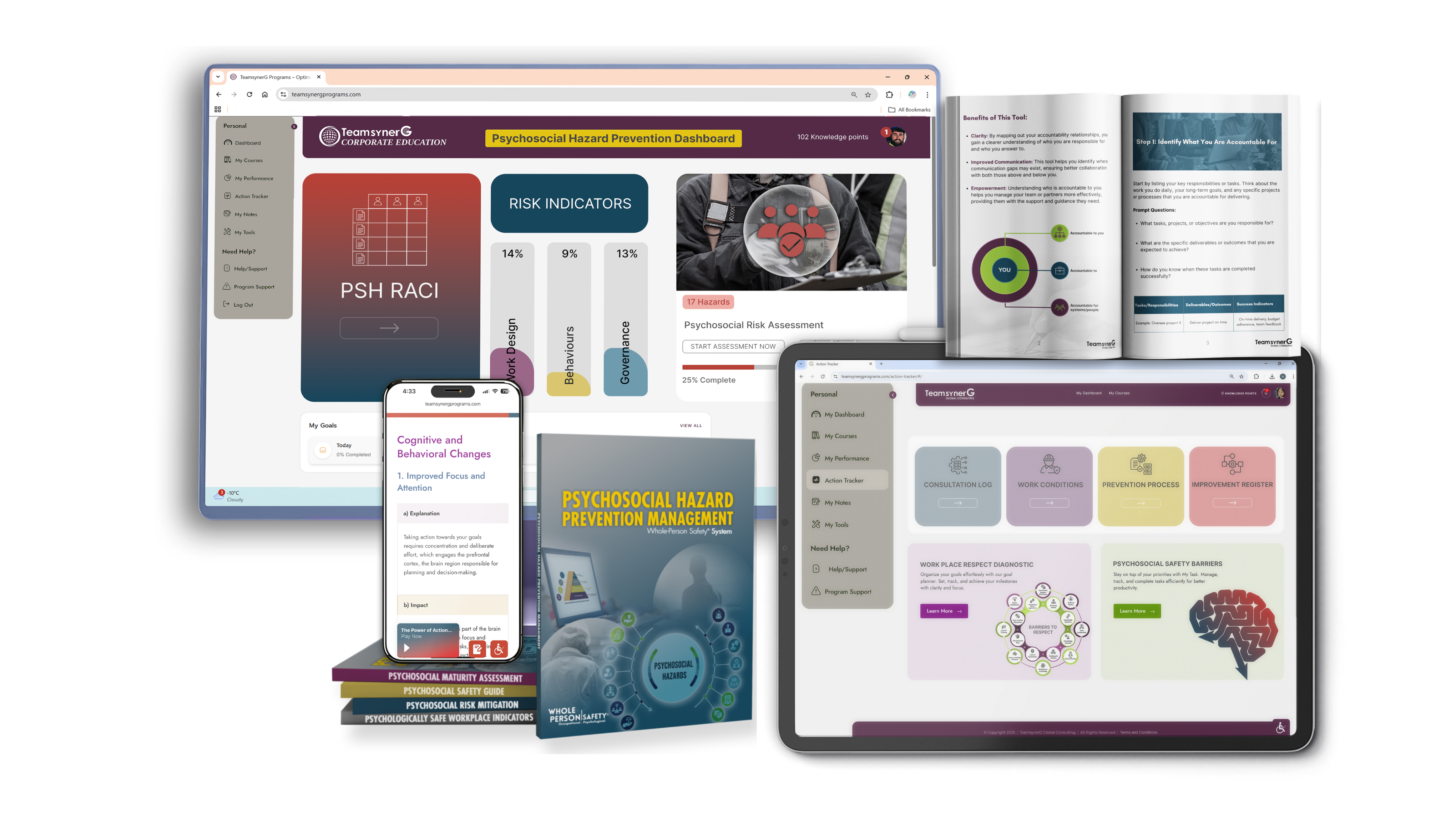
Whole Person Safety is the first integrated prevention-based system designed to protect the entire human experience at work by aligning physical, psychological, physiological, and psychosocial safety within a single, coherent framework. The framework is built on six fundamental human safety zones, supported by 22 standards and 84 indicators, providing organizations with a structured, measurable, and defensible approach to preventing harm at the source. The Whole-Person Safety provides practical comprehensive tools and methods that enable organizations to proactively identify, assess, and mitigate risks, creating cultures of accountability, inclusion, and psychological safety while sustaining high performance, profitability, and workforce resilience.
From the practical implementation of respect in the workplace to the prevention and management of psychosocial hazards, this system is designed to transform behaviours, leadership practices, and organizational systems, shaping the real lived experience of work and delivering whole-person protection through prevention in complex, high-consequence environments.
Psychosocial Hazard Prevention Management Certification
A globally aligned certification that builds defensible psychosocial hazard prevention capability through competency in identification, assessment, and control, aligned with ISO 45001 and ISO 45003, and supporting Work Health and Safety (WHS) compliance.
[smartslider3 slider="2"]