
- ABOUT
- CONSULTING
- TRAINING
- COACHING
- DIGITAL SYSTEMS
- PRODUCTS
- RESOURCES
- CONTACT

HomePsychosocial and Psychological...
Psychosocial and Psychological safety in the professional training Industry
Psychosocial Hazard Prevention and Risk Management Certification
ISO 45003 Psychosocial Risk Management Training for Workplace Implementation
A globally aligned certification that builds defensible psychosocial hazard prevention capability through competency in identification, assessment, and control, aligned with ISO 45003, and supporting Work Health and Safety (WHS) compliance.
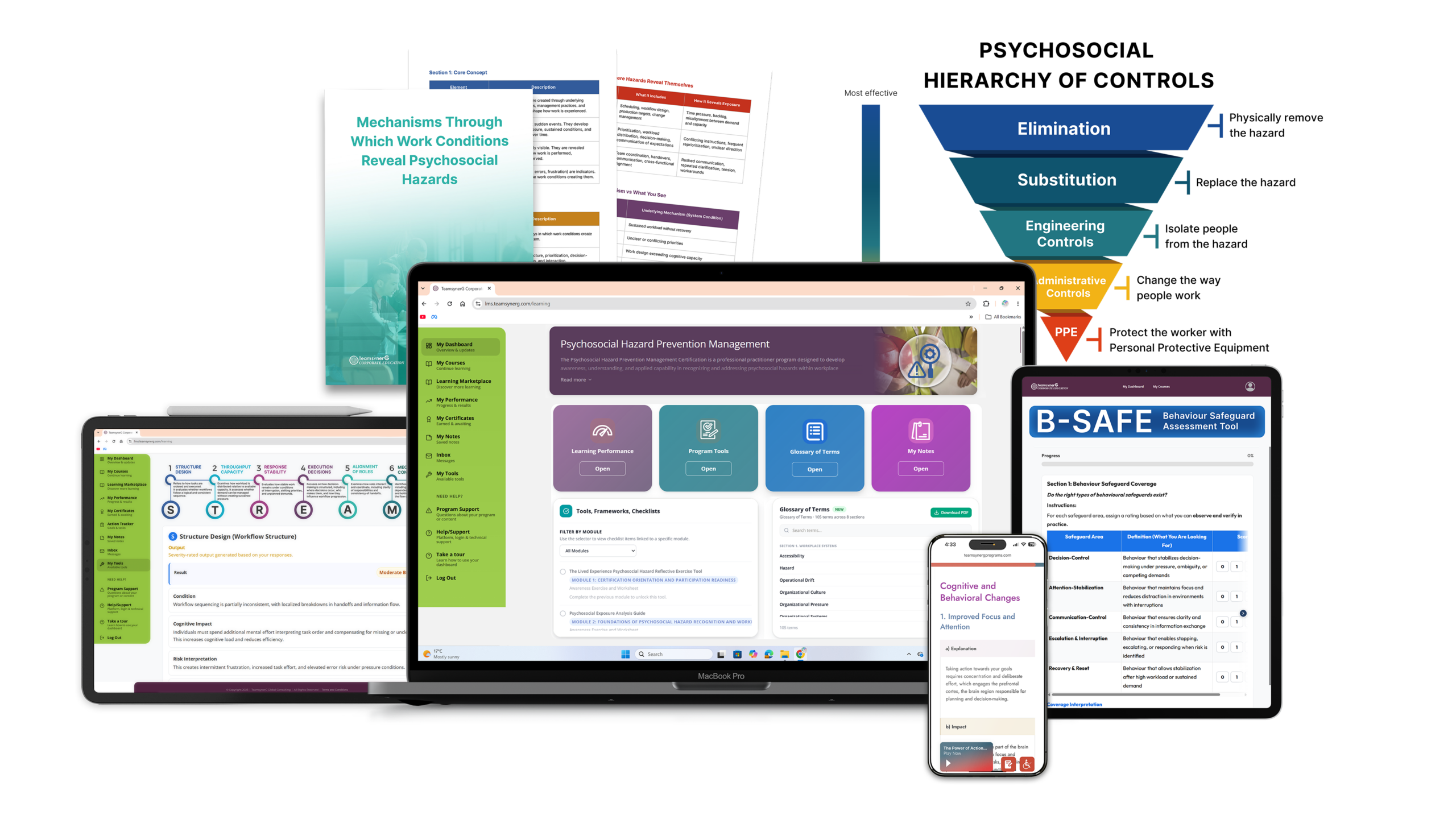







Applied Psychosocial Hazard Training Designed for Real-World Implementation
Program Delivery:
- 8 Live Lessons | 90 Minutes + Coaching and Q&A
- Expert Led Lessons + Self-Paced Learning Modules
- All Live Classes Are Recorded if You Cannot Attend
- 30 Plus Digital Psychosocial Hazard Management Tools and Resources
Upcoming Dates:
Wednesdays- October 21st to December 9th 6pm EST

Curriculum Learning Pathway Overview
Structured, practical learning designed for real-world implementation and sustained organizational capability.
9 modules
89 lessons
- Topic 1: Preparing for your Learning Journey
- Topic 2: Program Syllabus
- Topic 3: The Lived Experience Psychosocial Hazard Reflective Exercise
- Topic 4: PHPM Glossary of Terms
- Topic 5: Commitment to Learning Path
- Topic 1: The Evolution of Safety Thinking
- Topic 2: The Emergence of Psychosocial Hazards in Contemporary Occupational Safety
- Topic 3: Conceptual Definition and Scope of Psychosocial Hazards
- Topic 4: Psychosocial Risk Management and Terminology within International Safety Frameworks
- Topic 5: Work Design and Organizational Systems as Structural Drivers of Psychosocial Risk
- Topic 6: Leadership, Organizational Change Dynamics and Communication Failures
- Topic 7: Understanding the Learning Comprehension Diagnostic (LCD)
- Topic 8: Scoring Interpretation and Adaptive Feedback Guide
- Topic 9: Neuroscientific and Physiological Impacts of Psychosocial Exposure on Individuals
- Topic 10: Psychosocial Hazards and Their Influence on Team Function and Organizational Culture
- Topic 11: Operational and Safety Consequences of Psychosocial Hazard Exposure
- Topic 12: Psychosocial Exposure Analysis Guide (PEAG)
- Topic 1: Cognitive Function and Human Performance Under Workplace Stress
- Topic 2: Emotional Regulation and Behavioural Responses to Workplace Stressors
- Topic 3: Physiological Stress Signals in Occupational Settings
- Topic 4: Exposure Dose, Stress Response to Workplace Stress and Recovery Mechanisms
- Topic 5: Workload and Resource Imbalance as Systemic Stress Drivers
- Topic 6: Role Clarity Failures and Change Management Pressures
- Topic 7: Leadership Behaviour and Workplace Social Climate Indicators
- Topic 8: Operational Indicators of Organizational Overload
- Topic 9: Understanding and Recognizing Psychosocial Hazard Indicators
- Topic 1: Operational Performance Consequences of Psychosocial Hazards
- Topic 2: Operational Performance Consequences of Psychosocial Hazards
- Topic 3: Organizational Risk Exposure Created by Psychosocial Hazards
- Topic 4: Organizational Culture Signals Associated with Psychosocial Hazard Exposure
- Topic 5: Interpretation Discipline and Culture Signal Tool
- Topic 6: Pathways Linking Hazards to Organizational Outcomes
- Topic 7: Direct and Indirect Organizational Cost Impacts of Psychosocial Hazards
- Topic 8: Organizational Values and Behaviour Alignment
- Topic 9: Duty of Care Responsibilities in Psychosocial Hazard Prevention
- Topic 10: Governance Alignment and Organizational Response Systems
- Topic 11: Leading and Lagging Indicators of Psychosocial Risk Exposure
- Topic 12: Interpreting Psychosocial Risk in Real Work Environments - Applied Digital Practice Tool
- Topic 1: Conceptual Foundations of Psychosocial Hazard Diagnosis in Risk Management Systems
- Topic 2: From Discovery to Diagnosis: Translating Work Observations into Psychosocial Hazard Evidence
- Topic 3: Mechanisms Through Which Work Conditions Reveal Psychosocial Hazards
- Topic 4: Recognition of Psychosocial Hazard Patterns Through Evidence Triangulation
- Topic 5: Psychosocial Hazard Recognition Checklist
- Topic 6: Understanding Structured Documentation of Psychosocial Hazards for Risk Assessment
- Topic 7: Conceptual Classification of Psychosocial Risk Indicators
- Topic 8: Psychosocial Risk Indicator Classification Exercise
- Topic 9: Mechanisms Affecting Psychosocial Risk Data Integrity
- Topic 10: Psychosocial Risk Data Integrity Checklist
- Topic 11: Recognition of Bias and Analytical Blind Spots in Psychosocial Risk Interpretation
- Topic 12: Evidence-Based Risk Prioritization and Governance Documentation
- Topic 13: Evidence-Based Risk Prioritization Checklist
- Topic 1: Foundations of Psychosocial Risk Control Design
- Topic 2: Psychosocial Hierarchy of Controls (System-Level Application)
- Topic 3: Administrative Controls in Systems of Work
- Topic 4: Process Redesign as the Primary Risk Reduction Mechanism
- Topic 5: STREAM Diagnostic Tool
- Topic 6: Behaviour Safety Routines as Operational Safeguards
- Topic 7: B-SAFE: Behaviour Safeguard Assessment Tool
- Topic 8: Organizational Guardrails and Workload Protection Mechanisms
- Topic 9: Control System Integration and Interaction
- Topic 1: Process Redesign Application and Role Clarity
- Topic 2: Psychosocial Process in Action and RACI and Decision Authority
- Topic 3: Traceability Mapping: Connecting Hazards, Drivers, Indicators, and Controls
- Topic 4: Psychosocial Hazard Traceability Mapping Tool
- Topic 5: Fit-for-Cause Control Logic in Work Design and Supervision
- Topic 6: Control Failure: Why Controls Break Down in Organizations
- Topic 7: Equity and Accessibility Considerations in Control Design
- Topic 8: Organizational Enablers and Dependencies for Control Implementation
- Topic 9: Standards Alignment and Legal Defensibility in Psychosocial Risk Management
- Topic 10: Organizational Readiness for Control Implementation
- Topic 1: Psychosocial Safety Climate as a System Condition
- Topic 2: Communication as a Risk Control Mechanism
- Topic 3: Effective Communication System Design for Psychosocial Safety
- Topic 4: The 12-Step Communication System Design and Implementation Standard for Psychosocial Safety
- Topic 5: Communication Control Verification and Monitoring for Psychosocial Safety
- Topic 6: Leadership Governance and Accountability in Workload Hazard Prevention
- Topic 7: Shift-Start Huddles as Real-Time Risk Detection and Adjustment
- Topic 8: Micro-Checks and Pulse Monitoring as Early Signal Detection Systems
- Topic 9: Preventing System Drift and Sustaining Control Integrity Over Time
- Topic 10: Practice-Level Assessment: System Drift Diagnosis and Control Redesign
- Topic 11: Sustaining Psychosocial Safety as a Governed System
- Topic 1: Introduction to your 4 Part Capstone Exam
- Topic 2: Instructions to Complete the 4 Part Capstone
- Topic 3: Capstone Part A- Foundational Psychosocial Hazard Recognition and Evidence Interpretation
- Topic 4: Capstone Part B- Advanced Professional Analysis
- Topic 5: Capstone Part C- Advanced Control Design, Governance, and Sustainability
- Topic 6: Capstone Part D- Executive Strategic Psychosocial Risk Governance and Organizational Decision-Making
- Topic 7: Knowledge Testing Final Exam
- Topic 8: The Responsibility Behind the Work
Operationalize Psychosocial Risk Management Within Real Systems of Work
This certification is built on the understanding that psychosocial risk is not managed through awareness alone, but through structured, system-level prevention grounded in recognized standards and real operating conditions. It is designed to move beyond interpretation of standards into operational application within real environments, where risk is created, decisions are made, and accountability must be demonstrated. Participants develop the capability to translate requirements into practice, embed controls within systems and processes, and support decisions that are consistent, documented, and defensible under scrutiny.
Builds Defensible Psychosocial Hazard Prevention Capability
- Identify psychosocial hazards arising from work design, leadership practices, and organizational systems
- Assess psychosocial risk using structured criteria aligned with international standards design and evaluate control measures that address root causes within systems of work
- Practical digital tools, structured frameworks, and real-world case analysis, participants move beyond awareness to establish practical, repeatable capability in psychosocial hazard prevention.
- Psychosocial hazards are now recognized as critical contributors to workplace harm, operational disruption, and organizational risk. This program is designed to operationalize these requirements through a structured prevention methodology.
Earn your Global Certification and Lead Psychosocial Safety in the Workplace
This certification enables organizations and professionals to OPERATIONALIZE ISO 45001 /45003, WHS and broader OHS psychological health and safety standards frameworks.
- Conduct psychosocial hazard identification, complete structured risk assessments, design prevention and control measures, and implement audit and governance tracking systems using practical tools.
- Translate psychosocial exposure into measurable cognitive and performance risk indicators. Align prevention controls with how sustained stress affects decision quality and human error.
- Through the Whole Person Safety framework, implement neuro-safety principles within work design and leadership systems to prevent psychological harm before it occurs.
- Develop capability in hazard diagnosis using evidence triangulation, data integrity evaluation, bias recognition, and structured documentation of psychosocial risk.
- Examines the operational, cultural, and financial impacts of psychosocial hazards, including risk exposure, organizational performance, and duty of care responsibilities.
- Establish ongoing governance review cycles that monitor psychosocial exposure trends and drive continuous system improvement.
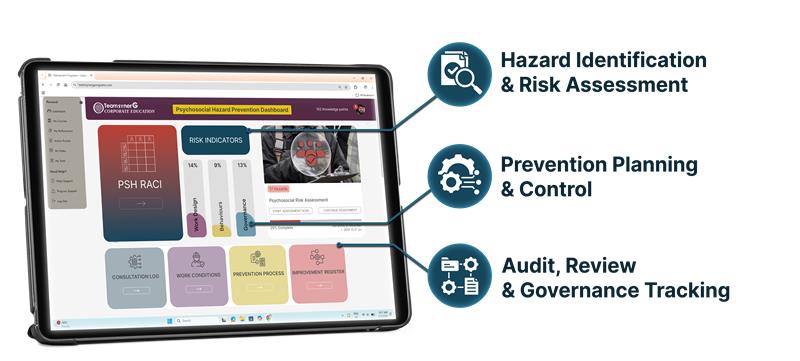
Prevent Psychosocial Hazards where work Actually Happens
The Psychosocial Hazard Prevention Management (PHPM) Certification is a professional practitioner certification designed to develop structured, standards-aligned capability in the identification, assessment, control, and governance of psychosocial risk within workplace systems.
This certification equips participants with the capability to operationalize these requirements through the application of the PHPM operating system, a structured methodology that integrates hazard identification, evidence-based risk assessment, control design, and governance documentation. Through a combination of applied tools, structured frameworks, and real-world case analysis, participants move beyond awareness to establish practical, repeatable capability in psychosocial hazard prevention.
Key Questions Answered
Understanding Psychosocial Risk
Psychosocial hazards are conditions within the design, management, and social environment of work that have the potential to cause psychological harm. These hazards are not based on individual sensitivity. They are created by how work is structured, how leadership operates, and how systems function.
Examples include excessive workload, lack of role clarity, poor change management, inadequate support, and workplace behaviours that create exclusion or fear.
Understanding psychosocial hazards requires moving beyond perception and identifying the underlying system conditions that create risk.
Psychosocial risk refers to the likelihood that workplace conditions will cause harm. Mental health refers to the outcome experienced by an individual.
This distinction is critical. Organizations are responsible for identifying and managing risk within the system, not diagnosing individual mental health conditions. When psychosocial hazards are not effectively managed, they increase the probability of negative mental health outcomes.
This certification focuses on prevention at the system level, not individual treatment.
Psychological harm does not occur from a single event in most cases. It develops through repeated exposure to conditions such as sustained pressure, lack of recovery, unclear expectations, or unsafe interpersonal environments.
Over time, these conditions impact cognitive function, emotional regulation, and physiological stress responses. When exposure continues without intervention, the risk of harm increases.
This program teaches how to identify these patterns early and intervene before harm occurs.
A psychosocial hazard is the source or condition within the workplace.
Risk is the likelihood that the hazard will cause harm.
Harm is the outcome experienced by the individual.
For example, unclear role expectations are a hazard. The risk is confusion, error, and sustained stress. The harm may present as burnout, anxiety, or cognitive fatigue.
This distinction is essential for accurate diagnosis and effective prevention.
Engagement surveys capture perception at a single point in time. They do not provide sufficient depth to diagnose whether a hazard exists or whether it is creating risk of harm.
Effective psychosocial hazard identification requires:
• multiple data sources
• behavioral and operational indicators
• structured evaluation of data integrity
• triangulation of evidence
This certification teaches how to move from perception-based insight to evidence-based diagnosis.
Compliance and Standards Alignment
This certification provides the operational capability required to implement and demonstrate alignment with ISO 45001 and ISO 45003.
Participants learn how to:
• Identify psychosocial hazards within the system
• Assess risk using structured and defensible methods
• Implement controls aligned with organizational processes
• Produce evidence that supports audit and compliance requirements
The focus is not on interpreting the standard. It is on applying it in real environments.
Yes. The program is designed to support alignment with:
• ISO 45001 and ISO 45003
• WHS legislation in Australia
• CSA and Canadian psychological health and safety standards
• Broader global occupational health and safety frameworks
The certification equips leaders and practitioners with the capability to operationalize these requirements within their organization.
Due diligence requires evidence that psychosocial hazards are being:
• Identified systematically
• Assessed using credible data
• Controlled through defined actions
• Monitored over time
This program teaches how to build defensible processes and documentation that demonstrate this capability during audits or regulatory review.
Organizations must demonstrate:
• Structured identification of hazards
• Documented risk assessments
• Clear linkage between hazards and controls
• Evidence of monitoring and continuous improvement
This certification provides the frameworks and tools to generate that evidence in a consistent and auditable way.
Program Outcomes and Capability
You will be able to:
• Identify psychosocial hazards within organizational systems
• Distinguish between perception, observation, and evidence
• Assess risk using structured and defensible methods
• Apply triangulation across multiple data sources
• Determine whether patterns are credible and require intervention
• Support compliance with regulatory and international standards
• Communicate findings in a way that informs leadership decisions
The outcome is applied capability, not theoretical knowledge.
Most programs focus on awareness, behaviors, or culture at a surface level. This certification focuses on system-level prevention.
It teaches:
• How hazards are created within systems
• How to diagnose them using evidence
• How to assess risk and prioritize action
The difference is the shift from conversation to operational capability.
Yes. Participants learn a structured approach to:
• Collect and evaluate multiple data sources
• Assess data integrity
• Identify patterns through triangulation
• Determine whether a hazard is present
• Assess the level of risk
This reflects the same logic used in defensible assessment and reporting systems.
Yes. The program is designed for immediate application.
Participants receive:
• Practical tools and frameworks
• Structured assessment methods
• Guidance on interpreting findings
• Approaches to communicating results to leadership
The intent is to enable real-world use, not future consideration.
Who This Certification Is For
This certification is designed for:
• Executives and senior leaders responsible for governance
• HR and people leaders are responsible for culture and systems
• Health and safety professionals
• Operational leaders managing teams and performance
• Risk Management and Psychological Harm Prevention professionals
It is particularly relevant for organizations operating in high-risk or high-demand environments.
No prior certification is required. However, the program is designed for professionals responsible for leadership, safety, HR, or organizational performance.
The content is structured to build capability from foundational understanding to applied practice.
Both. Individuals can complete the certification to build personal capability, while organizations can enroll teams to build internal capacity and align their approach across functions.
Implementation and Delivery
The certification is delivered through a structured learning experience that combines:
• Guided instruction
• Applied exercises
• Real-world scenarios
• Practical tools and frameworks
It is designed to support both understanding and application.
10 weeks and for customized corporate programs, it is structured to allow completion within a defined timeframe while ensuring depth of learning. Specific timelines depend on delivery format and cohort structure.
Participants gain access to an integrated PHPM operating system that enables real-time identification, assessment, and interpretation of psychosocial risk.
Participants receive access to:
- Psychosocial Hazard Identification and assessment frameworks
- digital evaluation, reporting and data integrity tools
- prevention planning tools
- downloadable forms, checklists
- audit review and governance tracking
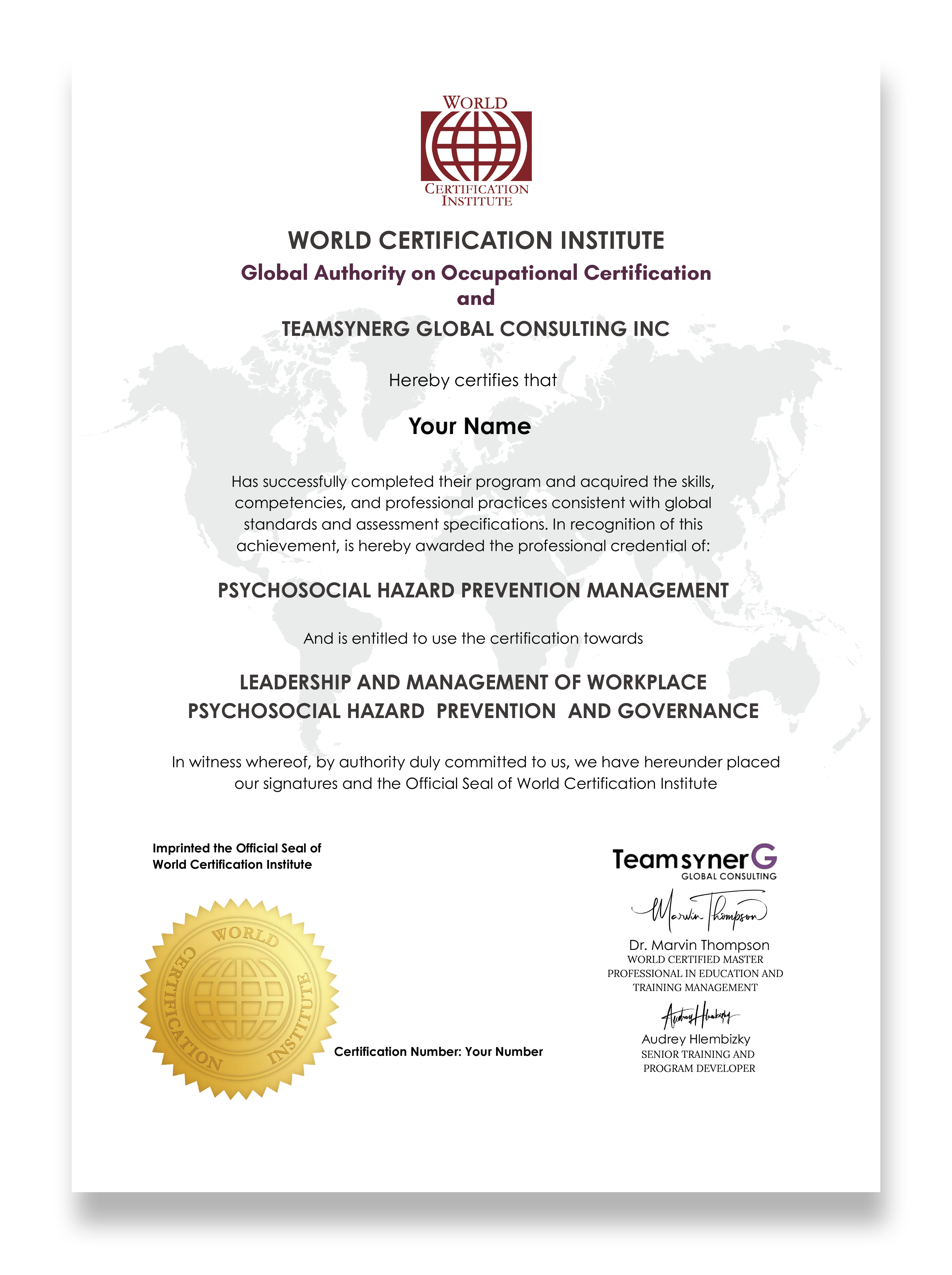
Yes. Upon completion, participants are certified in psychosocial hazard prevention, demonstrating capability aligned with international standards and organizational requirements.
Ongoing support is available to help participants apply the methodology within their organization, ensuring that learning translates into measurable impact.
Advanced Practice and Methodology
Data integrity is established by evaluating:
• accuracy of the data
• completeness of information
• consistency across sources
• reliability of findings
Without this step, conclusions may be biased or incomplete. This program teaches how to validate data before making decisions.
Triangulation is the process of comparing multiple data sources to determine whether a pattern is credible.
It ensures that conclusions are not based on a single perspective, but are supported by:
• Human experience
• Observed behavior
• System-level indicators
This is a critical component of defensible diagnosis.
Operationalizing means embedding psychosocial hazard prevention into:
• Systems and processes
• Leadership practices
• Risk management frameworks
• Continuous improvement cycles
It moves the organization from awareness to structured, measurable action.
Organizations must demonstrate:
• Structured identification of hazards
• Documented risk assessments
• Clear linkage between hazards and controls
• Evidence of monitoring and continuous improvement
This certification provides the frameworks and tools to generate that evidence in a consistent and auditable way.
Build Practical, Defensible Psychosocial Hazard Prevention Capability
This certification program builds practical prevention capability for professionals accountable for human resources policy, duty of care, safety outcomes, workforce sustainability, and governance. In other words, it is designed for those whose decisions shape how work is designed, led, and experienced. You will move beyond awareness. Instead, you will develop implementation capability. Specifically, you will learn how to identify psychosocial hazards in real work conditions and assess risk using structured, defensible logic. Then, you will determine what must be addressed first. As a result, you will be able to prioritize action based on severity, likelihood, and exposure. In addition, you will design prevention controls that align with operational realities rather than theory. Ultimately, the program equips you to integrate prevention into leadership behavior, operational routines, and governance systems. Therefore, you reduce exposure and mitigate the risk of whole-person harm.
- Build prevention capability that works in real organizational conditions. As a result, you reduce psychosocial risk where work actually happens.
- Strengthen defensible, standards-aligned decision-making. Therefore, you can confidently stand behind your actions with leadership and regulators.
- Apply practical tools and methods directly within your organization. In turn, you translate learning into documented action, accountable systems, and sustained prevention outcomes.
Psychosocial hazards are foreseeable workplace conditions. They influence both psychological and physical health. Therefore, they require structured prevention management.
Lead Psychosocial Hazard Prevention with Confidence,
Credibility, and Accountability

Prevent psychosocial hazards where work actually happens
Identify real workloads, leadership behaviours, change processes, and daily operational pressures before they translate into harm, disengagement, or incidents.
Lead cultures of prevention that protect people and performance
Move organizations from reacting after people are already impacted to building systems, behaviours, and routines that prevent harm and sustain performance and psychological safety over time.
Reduce organizational risk with confidence and credibility
Translate human strain into clear risk priorities, defensible prevention decisions, and documented evidence that holds up to scrutiny from executives, regulators, and boards.
Stay credible as standards and expectations continue to evolve
Maintain a living, globally aligned certification that evolves with emerging standards and jurisdictional requirements, ensuring your prevention capability remains current, defensible, and trusted.
Take the Next Step in Risk Management
How You Will Apply Prevention in Real Work Systems
- Identify psychosocial hazards within real work systems. Specifically, you will analyze work design, workload, leadership behavior, change processes, scheduling, and broader organizational conditions.
- Interpret how psychosocial hazards affect human performance and safety. As a result, you will translate cognitive, emotional, behavioral, and physiological impacts into actionable risk signals.
- Distinguish between psychosocial hazards, risk factors, and outcomes. Therefore, your assessments remain accurate and your decisions defensible.
- Conduct structured gap assessments to identify chronic or sustained exposure patterns. In turn, you will determine where system-level intervention is required.
- Prioritize psychosocial risks using standards-aligned logic rather than personal judgment or reactive escalation. Consequently, prevention efforts become structured and defensible.
- Design and lead prevention-focused initiatives that address systemic barriers. At the same time, you strengthen cognitive and emotional capacity within the workforce.
- Develop, implement, and document psychosocial risk mitigation plans. As a result, your actions withstand internal and external scrutiny.
- Interpret and apply global psychosocial hazard standards across industries. Ultimately, you build prevention systems that align with evolving regulatory expectations.

Create Sustainable, Psychologically Safe, and Accountable Work Environments
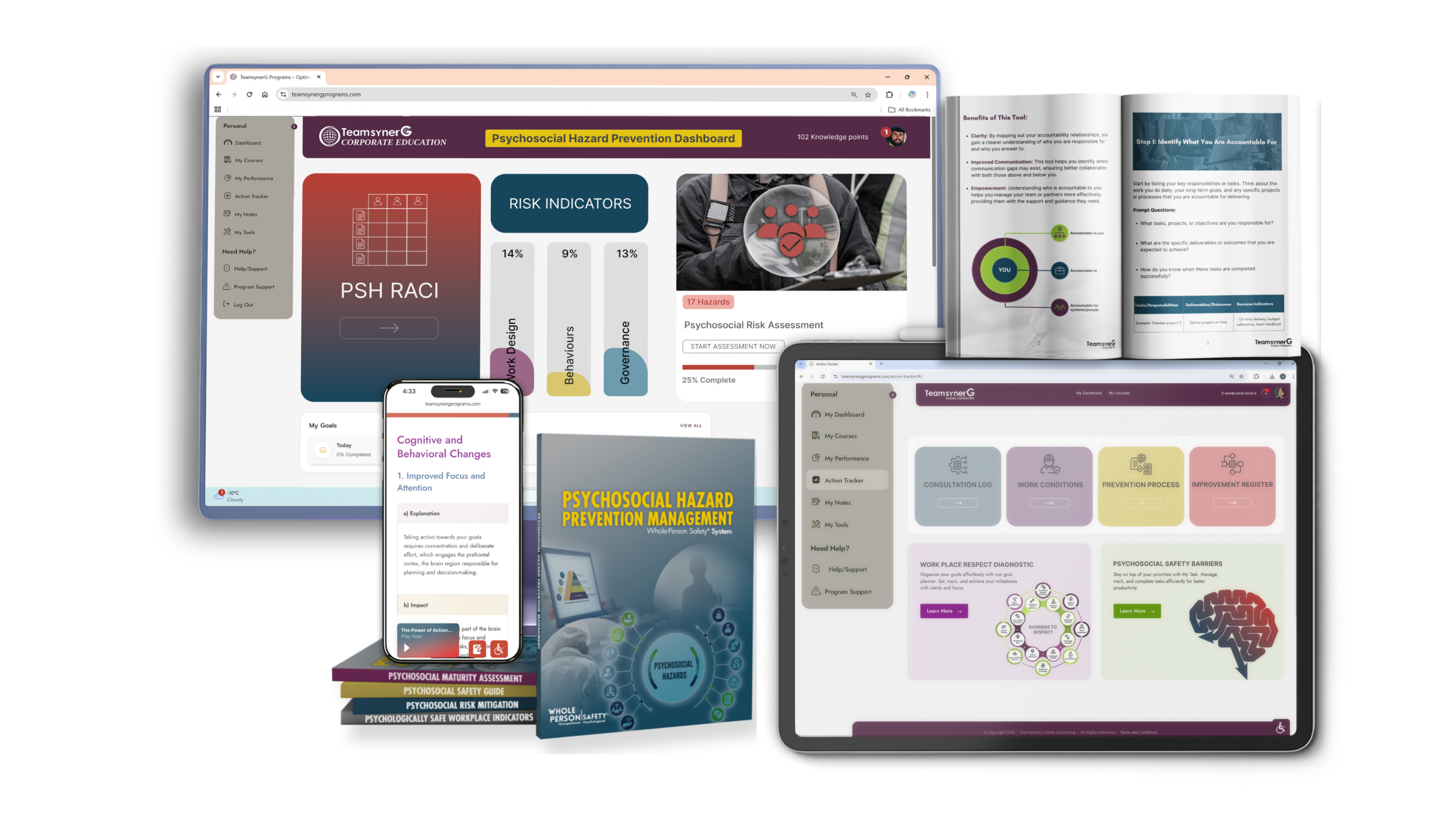
The Prevention Infrastructure and Tools You Will Apply
- Access a complete, practice-based prevention infrastructure. As a result, you can implement consistent and defensible psychosocial hazard prevention in real workplace conditions.
- Use a structured suite of prevention tools to support ongoing risk identification, accountability, execution, and follow-through. In other words, prevention becomes systematic rather than reactive.
- Apply governance and documentation resources, including templates, case studies, and operational tools. Therefore, expectations remain clear and decisions remain aligned with performance standards.
- Complete leadership self-assessments with individualized tracking. This supports measurable growth in prevention capability using cognitive and behavioral metrics.
- Lead applied implementation projects that translate prevention principles into documented action. Consequently, you demonstrate measurable system improvement.
- Work through realistic case studies and applied assessments. As a result, you reinforce consistent application across different organizational contexts.
- Access all tools, resources, and assessments through the Bioptrics behavior-based learning system. This enables repeatable use, long-term integration, and continuous improvement.
The Minds Behind the Method
35 years of Proven Proprietary Tools, Strategies and Training
Dr. Marvin Thompson

About Dr. Marvin Thompson
Dr. Marvin Thompson is an internationally recognized expert in organizational transformation, executive leadership, and policy innovation. With a doctorate in Leadership & Policy Studies and more than 35 years of experience, he has led large-scale initiatives across North America, Africa, and Saudi Arabia, strengthening leadership capability and operational performance in complex environments.
As President of TeamsynerG Global Consulting, he directs multinational programs focused on executive development, workforce readiness, and process optimization. His research-driven leadership systems have demonstrated a 90% success rate in improving organizational performance and building leadership capacity at scale. Serving as the foundation for the co-creation of Whole-Person Safety® system and Bioptrics..
Dr. Thompson is recognized by the World Certification Institute as a World Certified Master Professional in Education & Training Management a distinction awarded to global leaders who have demonstrated mastery in professional education, leadership, and organizational advancement.
Audrey Hlembizky

About Audrey Hlembizky
Audrey Hlembizky is a global leader in culture engineering, leadership development, and executive coaching, with more than 35 years of experience transforming how organizations think, lead, and perform. As the Founder & CEO of TeamsynerG Global Consulting, she has worked across mining, agriculture, healthcare, and corporate sectors to embed accountability, inclusion, and leadership excellence into the systems that drive daily performance.
She is the creator of several proprietary methodologies grounded in behavioural psychology and organizational science, including the internationally recognized Whole Person Safety® framework and Bioptrics™, the first human-centered digital system that integrates behavioural learning, culture-health diagnostics, and workforce-development optimization into one unified platform.
Her work centers on a clear vision: Organizations where accountability and psychological safety are foundational to how people lead, work, and succeed, not an afterthought or a compliance exercise.
Psychosocial Hazard Prevention Management Certification
A globally aligned certification that builds defensible psychosocial hazard prevention capability through competency in identification, assessment, and control, aligned with ISO 45001 and ISO 45003, and supporting Work Health and Safety (WHS) compliance.
Who This Certification Is For
his certification is designed for professionals accountable for people, risk, and performance in complex environments. In other words, it is built for those expected to prevent harm, lead through complexity, and create systems that protect the whole person at work.
- Health and Safety professionals accountable for identifying, assessing, and preventing psychosocial risk in regulated and high-risk environments.
- Human Resources, People, and Workplace Mental Health leaders responsible for psychosocial safety, workforce sustainability, and managing human risk beyond wellness programs.
- Managers and supervisors in high-risk or high-pressure industries who influence how work is designed, experienced, and sustained.
- ESG and Social Performance leaders accountable for workforce wellbeing, social risk, and credible prevention practices within ESG commitments.
- Organizational culture, DEI, and psychosocial safety professionals responsible for embedding prevention, accountability, and dignity into systems and leadership practice.
- Independent consultants and trainers working in psychosocial risk and safety who want to strengthen credibility, deepen prevention capability, and apply standards-aligned methods in client environments.
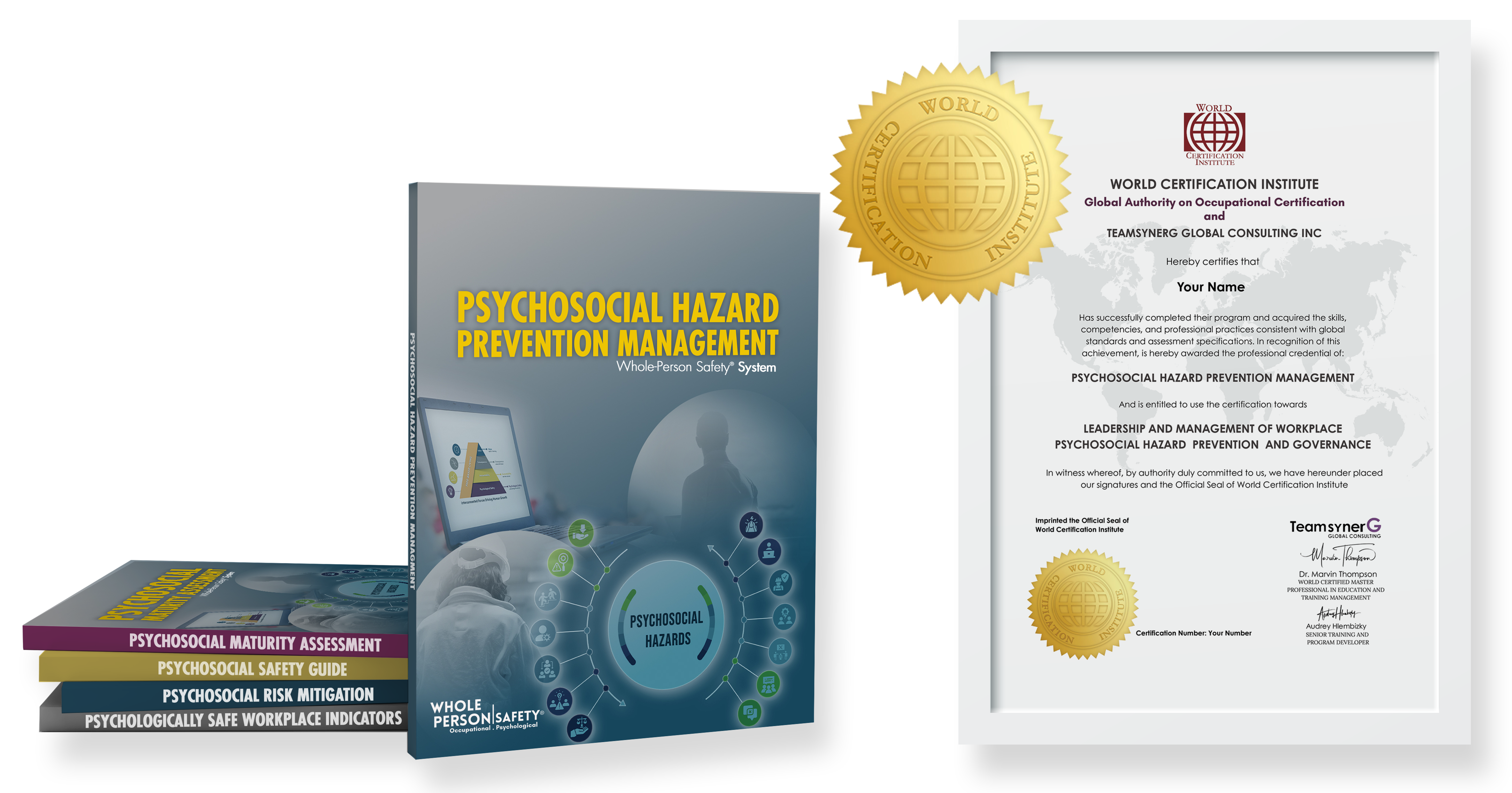
Backed by 35 years of proprietary tools, practical strategies, and real-world systems trusted by thousands worldwide.
⭐⭐⭐⭐⭐
" I am only a couple weeks and few modules in the Accountability Leadership Specialist certification with my amazing team that is with me on the journey to leading with clarity, consistency and accountability."
Sheryl B.
Human Resources Manager
⭐⭐⭐⭐⭐
"By learning the neurobiology of accountability and the concept that emotion hijacks integrity, I’ve gained tools to act from awareness rather than emotion. This Certification program isn’t just professional development, it’s human development."
Gail D.
Human Rights Lawyer
⭐⭐⭐⭐⭐
"This isn’t just another leadership course, it’s a transformational journey rooted in neuroscience, strategic execution, and real-world accountability. Every module is stretching my thinking, helping me understand how to lead with clarity, confidence, and purpose.
Bushra A.
Mining Engineer
Want a Team That Takes Ownership? We’ll Show You How to Build It…
Introducing the Certified Accountability Leadership Specialist (CALS) Program a neuroscience-based leadership system that transforms how teams think, act, and perform. We isolated the fundamental drivers of accountability and built a structured program that teaches you how to embed them into your daily leadership and your broader organizational culture.
THE GOAL:
To create an environment where people take initiative, follow through, and pursue a shared vision without waiting for instruction. And the results speak for themselves. Leaders who complete this certification report up to a 72% increase in goal, achievement, both personally and across their teams.
What You’ll Be Capable Of After This Certification:
- Leading a team of proactive contributors who take action without waiting for direction
- Communicating with precision, even in the most difficult or high-stakes conversations
- Advancing projects without the constant burden of follow-up, checking, or micromanaging
- Building a work culture grounded in trust, transparency, and shared accountability
- Energizing your team by connecting their work to meaning, purpose, and organizational impact
- Accelerating decision-making, reducing bottlenecks, and strengthening workflow efficiency
- Achieving consistent execution commitments delivered reliably, not negotiated
- Increasing operational discipline across your area of responsibility